Welcome

Monday, May 18, 2009

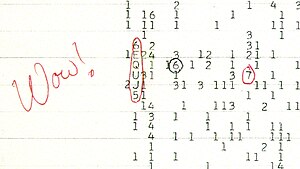
The original WOW signal.

The Wow! signal was a strong, narrowband radio signal detected by Dr. Jerry R. Ehman on August 15, 1977, while working on a SETI project at the Big Ear radio telescope of Ohio State University. The signal bore expected hallmarks of potential non-terrestrial and non-solar system origin. It lasted for 72 seconds, the full duration Big Ear observed it, but has not been detected again. It has been the focus of attention in the mainstream media when talking about SETI results.


The SETI Mystery Signal


SETI : Suddenly There Is A Signal of Unknown Origin

2004


A SETI mystery. All of sudden we have a signal from 1000 light years away. What is sending it ? Astonomers are trying to rule out earth-based anomalies - however the mystery is that the signal is not currently explainable. You can read more here and here. The mission of the SETI Institute is to explore, understand and explain the origin, nature and prevalence of life in the universe.

Sunday, May 17, 2009


http://www.alienseekernews.com/articles ... 01b1e57112

Project Condign

Nick Pope

May 16 2009


Nick Pope used to run the British Government's UFO project at the Ministry of Defense. Initially skeptical, his research and investigation into the UFO phenomenon and access to formerly classified government files on the subject soon convinced him that the phenomenon raised important defense and national security issues, especially when the witnesses were military pilots or where UFOs were tracked on radar.

The MOD's UFO Project had also been sent a number of intriguing photos and videos of UFOs, and had the means to have the images enhanced and analysed by various technical specialists. Some intriguing images had arrived via the Scottish Daily Record in 1990, and a poster-sized photograph had been produced from one of the negatives and pinned to my office wall by one of my predecessors. The photograph had been taken in daylight and showed a vast, diamond-shaped UFO, metallic silver in colour, apparently hovering low over the Scottish countryside.
On 15 May 2006, under the Freedom of Information Act, the Ministry of Defence published a formerly secret report on UFOs. Much information about UFOs has already been released, both at the National Archives and on the Ministry of Defence's website. The Freedom of Information Act came fully into force on 1 January 2005 and one of the subjects that is most frequently raised under the legislation is UFOs. There is massive public interest in the phenomenon. But the release of this latest study is different and totally unprecedented. The study was classified 'Secret UK Eyes Only' and only 11 copies of the report were ever made. It ran to over 460 pages and was codenamed 'Project Condign'. Work started in 1996 and the final report was not published until December 2000. The study's findings were sensational but the story behind the study was even more bizarre.

The Ministry of Defence first became involved in the UFO phenomenon in 1950 when the Department's Chief Scientific Adviser, the great radar pioneer Sir Henry Tizard, decreed that UFO sightings should not be dismissed without some form of proper, scientific study. The result was the most splendidly named committee in the history of the civil service, the Flying Saucer Working Party. Their conclusions, set out in a classified report from 1951, were sceptical: UFO sightings were misidentifications, hoaxes or delusions. Consequently, they recommended no further investigations be carried out.

Prime Minister Winston Churchill pressed the Air Ministry for answers in 1952. His letter - available for viewing at the National Archives - says "What does all this stuff about flying saucers amount to? What can it mean? What is the truth? Let me have a report at your convenience". The reply simply restated the party line. UFOs were of no defence significance. But later that year there was a high profile series of UFO encounters involving the RAF. UFOs were tracked on radar. Aircraft were scrambled. Pilots saw UFOs demonstrate speeds and manoeuvres that went far beyond anything the RAF were operating. And some of these mystery objects were filmed on the gun cameras carried on some of our aircraft.

The MOD and the RAF were forced to think again and the sceptical conclusions of the Flying Saucer Working Party were overturned. UFO sightings were to be reported and investigated, but could not be discussed with the media or the public. Guidance was set out in a 1956 document classified Secret. In 1965, in the course of liaison with the Americans, the Ministry of Defence confirmed that UFO sightings were investigated by "our Air Force Technical Intelligence Department". And in a statement that has led to accusations of cover-ups and conspiracies, the document went on to say "Our policy is to play down the subject of UFOs and to avoid attaching undue attention or publicity to it".

The MOD continued to receive reports of UFO sightings. Most were from the public, but some were from police officers, civil pilots or military personnel. The numbers varied. In 1976 we received 200 UFO reports. In 1978 we got 750. I joined the Ministry of Defence in 1985 and in 1991 was posted to the division then responsible for investigating UFO sightings. My brief was to see whether there was evidence of anything of any defence significance - any threat to the territorial integrity of the United Kingdom's Air Defence Region. What I found changed my life forever.

There has always been a sceptic versus believer debate raging at the heart of the Establishment in relation to the UFO phenomenon. Some people in Government thought the whole subject was a waste of time and money, while others thought it was an issue of critical importance. There were some surprising players in all of this. A former Chief of the Defence Staff, Lord Hill-Norton, believed some UFOs were extraterrestrial and that governments were covering up the truth. Former Royal equerry and Deputy Commander in Chief of RAF Strike Command Sir Peter Horsley wrote in his autobiography about an encounter with an alien. "Oh God, how unfortunate that the public will learn that the man who had his finger on the button at Strike Command was seeing little green men" commented a senior officer, anonymously, of course.

During my tour of duty on the UFO project, my conclusions generally mirrored those of my predecessors. Most UFOs could be explained as misidentifications of ordinary objects and phenomena: aircraft lights, weather balloons, satellites, meteors and the planet Venus. But some of the cases on our files were considerably more interesting:

* On 26 December 1980 a UFO landed in Rendlesham Forest next to the United States Air Force bases at Bentwaters and Woodbridge. One of the many military witnesses got close enough to touch the hull and sketch the strange symbols - which he likened to Egyptian hieroglyphs - that he saw on the craft. Indentations were found in the clearing where the UFO had landed and a Geiger counter was used to take radiation readings, subsequently assessed by the MOD's Defence Intelligence Staff as being "significantly higher than the average background". The UFO returned on the following night, when witnesses included the Deputy Base Commander, Lieutenant Colonel Charles Halt.


* On 30 March 1990 the Belgian Air Force tracked a UFO on radar and scrambled two F-16 fighters, with orders to intercept the UFO. The two aircraft 'locked on' to the UFO with their onboard radars, but the UFO repeatedly broke the lock and a bizarre game of cat and mouse played itself out over the next hour or so. I made enquiries about this with staff at our embassy in Brussels, and was told that the Belgian Government had assessed this event as real - an unknown craft had indeed been involved.


* On 5 November 1990, RAF Tornado aircraft flying over the North Sea were casually overtaken by a UFO. The pilot's report stated "UFO appeared in our right hand side ... we were travelling at Mach point 8. It went into our 12 o'clock and accelerated away. Another 2 Tornados saw it".


* On 30 March 1993 a massive wave of UFO sightings occurred over the UK, culminating in a massive triangular-shaped craft flying over RAF Cosford and RAF Shawbury in the Midlands. Witnesses included members of an RAF Police patrol, and a meteorological officer who saw a UFO that he said was several hundred feet in diameter, emitting a low frequency humming sound and firing a narrow beam of light down at the ground. It moved slowly across the countryside before shooting off to the horizon several times faster than an RAF fighter jet.

The MOD's UFO Project had also been sent a number of intriguing photos and videos of UFOs, and had the means to have the images enhanced and analysed by various technical specialists. Some intriguing images had arrived via the Scottish Daily Record in 1990, and a poster-sized photograph had been produced from one of the negatives and pinned to my office wall by one of my predecessors. The photograph had been taken in daylight and showed a vast, diamond-shaped UFO, metallic silver in colour, apparently hovering low over the Scottish countryside. The photograph was removed in 1994 by the then head of the division, who had convinced himself that the picture showed a secret prototype aircraft codenamed Aurora - a hypersonic replacement for the SR-71 Blackbird that the US Government denied existed. A question was asked in Parliament in 1996 about the location of this photograph, and the matter has subsequently been raised in a Freedom of Information Act request. Unfortunately, the photograph had disappeared, and could not be located.

This was the background to Project Condign. For 40 years a debate about UFOs had raged within the MOD and the RAF, with first the sceptics then the believers gaining the upper hand. We needed resolution. We needed a proper, in-depth scientific study that was going to look at all the evidence we'd amassed, and come to a definitive view about the UFO phenomenon. My opposite number in the Defence Intelligence Staff had first discussed this with me in 1993. Like me, he seemed intrigued by some of the UFO cases on our files, and some of our discussions about UFO aerodynamics and propulsion systems were like something from a 'Star Trek' script. Nothing was said openly, but when terrestrial explanations for some UFO cases were eliminated, fingers were pointed suggestively upwards. And whenever the question of UFO occupants was mentioned, the marvellous phrase "these people" was trotted out. "What did he mean 'these people'?" my boss asked me, on the way back from one particularly surreal briefing.

But how were we going to get a study commissioned when so many of our colleagues thought the MOD should drop its UFO investigations altogether - as the United States Air Force had in 1969, when their research programme, Project Blue Book, was closed down. One of our tactics was a simple linguistic sleight of hand - we banned the phrase 'UFO'!

One mention of the phrase 'UFO', and people's prejudices and belief systems kick in, be they sceptics or believers. The term was too emotive and had too much baggage. So we devised 'Unidentified Aerial Phenomena' (UAP) as a replacement, and tried to use this in all internal policy documents, retaining the phrase 'UFO' only for our dealings with the public.

It worked. With the phrase 'UFO' having been quietly dropped, we pushed to get a study approved. To my surprise and delight, given some of the more sceptical voices in the Department, resources were eventually obtained. I assessed the formal proposal, when it arrived, and recommended to my bosses that the study be commissioned. Against my expectation, my recommendation was accepted. However, the project was subsequently delayed, and in 1994 I was promoted and posted to a different section. Accordingly, I played no part in the study and am certainly not - as has been alleged on the internet - its anonymous author.

So what did we get? After four years and 460 pages of analysis, have we solved the UFO mystery? Well, no, we haven't. "That UAP exist is indisputable", the Executive Summary states, before going on to say that no evidence has been found to suggest they are "hostile or under any type of control". What we have is a comprehensive drawing together of some existing research, coupled with some exotic new theories. But by its own admission, the report has not provided a definitive explanation of the phenomenon: "although the study cannot offer the certainty of explanation of all UAP phenomena ..." it says, leaving the door open.

One of the areas that will be most contentious relates to what the report refers to as "plasma related fields". Electrically-charged atmospheric plasmas are credited with having given rise to some of the reports of vast triangular-shaped craft, while the interaction of such plasma fields with the temporal lobes in the brain is cited as another reason why people might feel they were having a strange experience. The problem with this is that there's no scientific consensus here, and as a good rule of thumb one shouldn't try to explain one unknown phenomenon by citing evidence of another. In other words, you can't explain one mystery with another one! That said, the opportunities presented here are recognised and the study recommends further investigation "into the applicability of various characteristics of plasmas in novel military applications".

The report also deals with flight safety issues. There are numerous UFO sightings involving pilots, and the Civil Aviation Authority has records of some terrifying near misses between aircraft and UFOs. In one such case, on 6 January 1995, a UFO came dangerously close to hitting a Boeing 737 with 60 passengers on board, on its approach to Manchester airport. The CAA commended the pilots for reporting the UFO and the official report states that both the degree of risk to the aircraft and the cause were "unassessable". Numerous RAF pilots have seen UFOs too. I have spoken to many such witnesses, not all of whom ever made an official UFO report. Project Condign has an intriguing recommendation when it comes to such aerial encounters: "No attempt should be made to out-manoeuvre a UAP during interception".

This is good news for all those with a serious interest in UFOs. The longest and most comprehensive UFO study ever undertaken in the United Kingdom is published, underpinning the MOD's commitment to the Freedom of Information Act and the principles of open government. Although some parts of the study have been quite properly withheld, as they relate to areas such as the capabilities of radar systems, the media and the public now have an insight into a world that was previously closed to them. The real X-Files have been opened and proof revealed as to just how seriously some of us in government viewed the UFO phenomenon, and how much hard work went into the effort to resolve one of the last great mysteries of our time.

Some commentators recently suggested that interest in UFOs was declining. The publication of this report looks set to reignite the debate and propel the subject back into the spotlight. UFOs - sorry, I mean UAPs - are back!

Saturday, May 16, 2009

"BIG NEWS" SETI Picks Up Regular Laser Pulse From Space


SETI Picks Up Regular Laser Pulse Emanating From Space

http://io9.com/5256360/seti-picks-up-re ... from-space

Fri May 15 2009

Astrophysicist Ragbir Bhathal works with SETI to scan the skies for possible communications from extraterrestrial intelligences. Unlike most SETI facilities, which look for radio signals, Bhathal's looks for laser pulses. And now he's found one.


Several years ago Bhathal, a researcher at the University of Western Sydney, suggested that a likely form of extraterrestrial communication would be laser bursts. He set up a facility at his lab which sweeps a nearby volume of space, within about 100 light years, for laser bursts that come in a regular pattern. Any kind of communication would likely be distinguished from background noise by coming in repeated or non-random patterns.

And a few months ago, Bhathal found the kind of regular pattern he's been looking for. He's been analyzing it and seeking a repeat pattern in the same area of space ever since. Though he's cautious about claiming it as a genuine extraterrestrial signal, his discovery has been making local news. Read all about it in The Australian.

http://www.theaustralian.news.com.au/st ... 17,00.html

Watch this space


Greg Callaghan | May 09, 2009

AFTER you've spent more than 20 years hunting for an alien signal, you think you'd be celebrating if you noticed a mysterious pulse suddenly rising up on your computer readouts. A regular pulse, amid the random clatter of the cosmos, suggests that someone very smart at the other end is sending a message.

But when Ragbir Bhathal, an astrophysicist at the University of Western Sydney, who teaches the only university-based course on SETI (search for extraterrestrial intelligence) in Australia, detected the suspicious signal on a clear night last December, he knew better than to crack open the special bottle of champagne he has tucked away for the history-making occasion.

Instead, he's spent the past few months meticulously investigating whether the unrecognised signature was caused by a glitch in his instrumentation, a rogue astrophysical phenomenon, or some unknown random noise.

Even if he picks up the signal again - he's been scouring the same co-ordinates of the night sky on an almost daily basis since - the scientific rule book dictates he'll need to get it peer-reviewed before he can take his announcement to the world. "And that is a lot of ifs," he concedes.

The hunt for extraterrestrial life has been boosted recently by the discovery last month of a rocky world not unlike our own, about 20 light years away, which its Swiss discoverers have dubbed Gliese 581e, the latest in a long line of planet discoveries during the past decade (350 and counting).

Although Gliese 581e is too close to its host sun to support life, it's the first planet believed to be rocky like our own, a kind of super-hot Earth quite unlike the long line of gas and ice giants discovered to date.

With the launch of NASA's Kepler space telescope in March, specifically designed to detect smaller Earth-like planets, astronomers are confident that the discovery of a blue planet, orbiting in the so-called Goldilocks zone, where liquid water can support life, is edging closer by the day. But it will still be up to ground-based telescopes to confirm the mass of the planet, as space-based telescopes such as the Kepler can only yield its approximate diameter.

The quest of SETI astronomers, however, is not just for the discovery of an Earth-like planet but for life intelligent enough to transmit meaningful signals across vast stretches of space. For more than 40 years, they have been doggedly searching for alien transmissions via radio telescope, tracking tens of millions of radio signals across different sections of the night sky, but so far the results have been, by any scientific standard, dismal.

There has been a handful of false alarms - the detection of short, intense bursts of electromagnetic energy that might be transmitted by an advanced civilization - but these have been later shown to be caused by other cosmic phenomena, such as quasars.

The belief that an alien civilization might also be listening to our television and radio signals has also been dashed by the recent discovery that the signals don't, as once thought, reach into deep space: they eventually become so weak that they disappear in the roar of the electromagnetic noise.

That is partly why the OZ OSETI (o for optical) project and a handful of its US counterparts have turned to laser pulse technology in what is the most ambitious effort yet to detect a signal from an alien species. "For an advanced civilization, radio wave technology would be old hat," Bhathal says. "My strong feeling is that if there are (extraterrestrial intelligence) civilizations out there, they will send the signal by laser pulses or laser flashes."

In 2000, science fiction writer Arthur C. Clarke, a former patron of the Australian SETI project, advised Bhathal to "let the better spectrum, light" drive his search for ET. Bhathal's OZ OSETI project is the only dedicated project for searching for ET in the optical spectrum in the southern hemisphere.

"NASA is already using lasers for space communication and it's not unrealistic to imagine that an extraterrestrial intelligence might be using them as well," Bhathal says.

"In terms of Earth technology today, we have achieved a maximum of 1015 watts of laser power for a brief period, butan advanced civilization could have lasers with powers of 1025." He admits, however, that our failure to pick up any interstellar signals so far could mean that advanced civilizations are using a communications technique still not discovered on Earth.

"It is risky to judge everything by our own technology," he says.

The search field of the OZ OSETI project is 100 light years from Earth: a short walk around the block in galactic terms, but an area large enough to contain at least 1000 stars and possibly 20 times as many planets.

While the discovery of worlds outside our solar system has given weight to the idea that the universe may be teeming with life - albeit sprinkled across an incomprehensibly wide area - it's the key cosmic numbers that have astronomers in disagreement.

For example, how often do the magic ingredients for life - a rocky planet, located at just the right distance from its sun at justthe right moment in the sun's life - come together?

If the answer is very often, there ought to be lots of planets like our own, and life may be more the rule than a miraculous accident. In 1960, Frank Drake, now a professor of astronomy at the University of Southern California, estimated that there could be up to a million technological civilizations in the Milky Way galaxy alone. But Bhathal believes "we are nowhere near being able to put a sensible figure on how common life may be".

What we do know is that our sun is a perfectly ordinary star in a rotating island of 100 billion stars, the Milky Way galaxy, which in turn is just one of 100 billion or so galaxies in the observable universe. The laws of mathematics weigh heavily in favour of the idea that we are not alone. Moreover, the discovery of more than 300 planets suggests that solar systems such as ours may not be all that unusual. It's very likely that smaller and rockier worlds are more common than the gas giants, which are easier to find because of the greater wriggle they exert in a star's path.

"The low-mass planets are much harder to find because they have a smaller Doppler amplitude," says Chris Tinney of the department of astrophysics at the University of NSW. "It might also mean we are not looking in the right way. But we're now certain that low-mass planets are more common. The Kepler space telescope will no doubt help usfind them."

Tinney explains that while the basic techniques for detecting planets have been around for some time, what's revolutionized the field has been the dramatic technological improvements in spectrograph and telescopic power.

"Planet searching has now become a sexy field and private donors in the US are putting money into it," Tinney says.

Other satellite projects such as the Allen telescope array, named after Paul Allen, the Microsoft co-founder who donated $US13million towards its creation, are also coming online. The array uses an incredible 350 satellite dishes to scan the sky for the faint whisper of radio signals from celestial objects such as quasars.

There's also the hardware already in space if ET happens to be passing through our neighbourhood. The Pioneer 10 spacecraft, launched in 1972, included an aluminum plate with human figures, a drawing of the planets and an outline of the spacecraft's course. The last, extremely weak signal from this surprisingly robust spacecraft was received in 2006. If it's still around, Pioneer 10 would now be hurtling somewhere in the interstellar void outside our solar system.

With the discovery of more planets, the relatively new science of exobiology, dedicated to the study of extraterrestrial life, has gained the gleam of scientific respectability.

But the field is still trying to overcome the UFO stigma, laments Ain de Horta, a project scientist with the Australian SETI Institute.

"There are still those in the scientific community who look down their noses at us, but that's increasingly unusual these days. There's a growing recognition that this is important science, with the potential to answer one of the most fundamental questions facing humanity. Those who lump us in with the UFO nuts tend not to be scientists," says de Horta.

"We're counting on the physics being the same elsewhere in the universe."

De Horta's institute is, in collaboration with CSIRO's Parkes telescope, scouring radio waves in its search for ET.

"If an alien civilization has developed technology it's likely to be based on most ofthe same principles as our own. Like us, forexample, they would have discovered radio waves."

Even so, de Horta concedes, life elsewhere in the universe might resemble nothing we know on Earth. It could be moulded by different chemistries, different gravity and different climatic environments.

In any case, it's highly unlikely we'll ever have a face-to-face meeting, as space travel even at Star Trek's warp drive wouldn't get us there in less than thousands of years. A two-way conversation would take decades. And even for that to happen, says de Horta, we would need intelligent life to be reaching its technological prime at the same time as ours and transmitting radio waves at a wavelength that we can detect.

"The whole argument about communication hinges on the longevity of a species and their use of a technology that is recognizable to us," he says.

What all the planet hunters and SETI have in common is a white-hot passion for discovering alien worlds. Bhathal knows that the odds of finding anything are long and the area he is scanning, as big as it is, may still not be extensive enough to yield anything, but he's determined to keep his eyes on the sky.

"There (have) to be other Earth-like worlds. Otherwise what do we have? A whole lot of wasted space."